
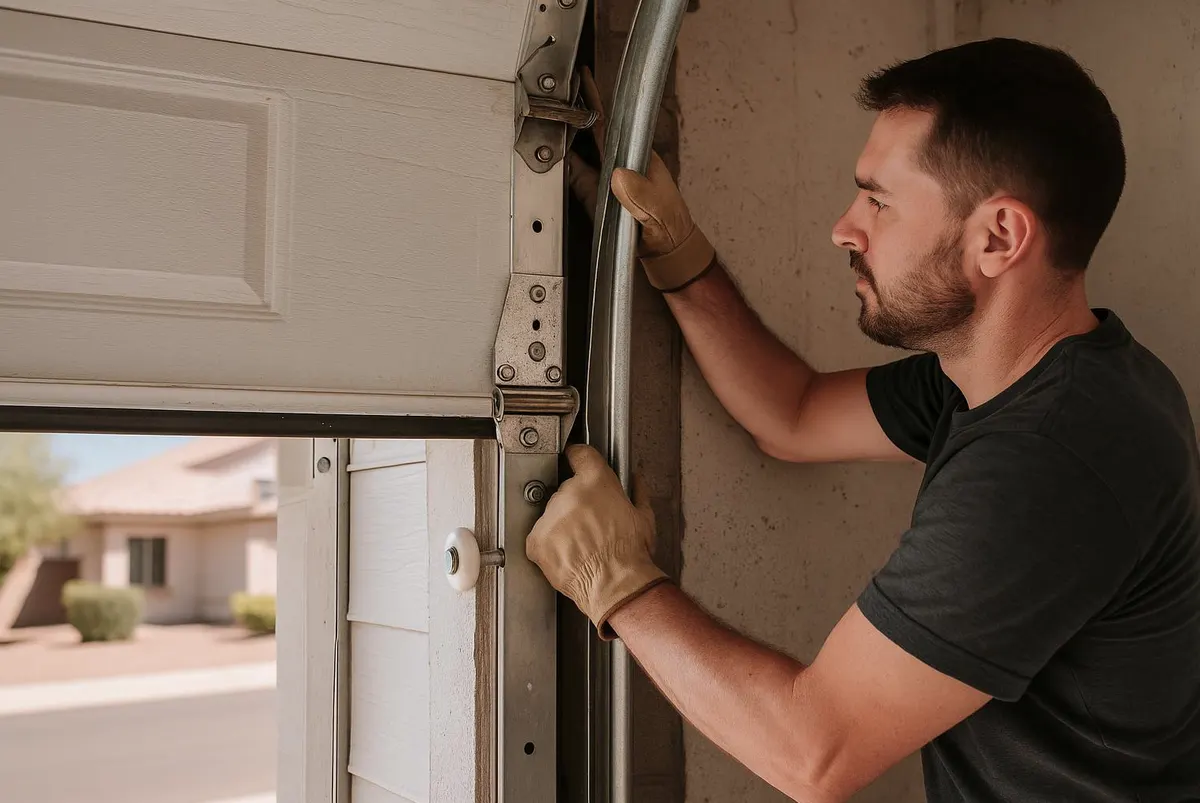
Rule of thumb: nine times out of ten, a garage door that won't open is a power problem or a spring problem, not a broken opener. The exceptions are worth knowing too — a stuck photo-eye sensor, a swollen door binding in its track after a week of afternoon downpours, or a manual release cord that got bumped loose can all stop a perfectly healthy door cold. Before you assume the worst, it helps to know what's actually going on, and what order a technician checks things in.
What You're Actually Seeing
The symptom tells you a lot about where to look first:
- Nothing happens at all — no motor sound, no clicking, no lights on the opener. This points to power.
- The opener hums or clicks, but the door doesn't move. Power is getting to the unit, but something downstream is blocked or broken.
- The door opens a few inches, then stops or reverses. Usually a sensor or obstruction issue, sometimes a track problem.
- The remote works but the wall switch doesn't, or vice versa. This isolates the problem to that specific control, not the door itself.
- The door moves fine by hand but not with the opener. This almost always means the opener is disconnected from the door, not broken.
The Order a Technician Checks Things
1. Power to the Opener
First stop, always. Garages here often run on a GFCI-protected outlet, and humidity or a power blip during a storm can trip it without you noticing. Check the outlet, check the breaker, and check that the cord is actually plugged in — vibration from heavy use or a nearby storm can work a plug loose over time. The fix here is a reset, not a repair.
2. The Safety Sensors
Every opener built in the last few decades has two small photo-eye sensors near the bottom of the tracks. If they're misaligned, dirty, or one has a blinking light instead of solid, the opener will refuse to close the door and may also hesitate on opening. Salt air and afternoon humidity leave a film on the lenses faster here than inland, so a quick wipe-down and realignment solves this more often than people expect. The fix: clean the lenses, make sure nothing (a storage bin, a bike, a shadow at the wrong angle) is blocking the beam, and nudge the brackets until both lights go solid.
3. Remote and Wall Switch
Dead batteries, a remote that's fallen out of range, or a wall switch with a loose wire. Cheap and fast to rule out — swap batteries, try the other control, and move on if it's not the issue.
4. The Manual Release Cord
That red cord hanging from the trolley disconnects the door from the opener so you can lift it by hand during a power outage. If it's been pulled — often by accident, sometimes by a curious kid or pet — the opener will run but the door won't move. Reconnecting it is usually a one-minute fix: pull the cord toward the door until the trolley re-engages the carriage, then test with the opener.
5. A Broken Spring
If the door won't budge even by hand, or it feels like it weighs twice what it should, a torsion or extension spring has likely failed. You may have heard a loud bang at some point — that's the spring letting go. On a torsion spring, you'll see a visible gap in the coil above the door. This is also the most common failure point on doors here, since wind-load-rated doors are heavier and put more daily strain on the springs than a standard door would. This is not a DIY fix. Torsion springs are under extreme tension, and a tech will replace them with springs matched to your door's exact weight and cycle rating, then re-balance the door so it holds position at any height.
6. A Snapped or Frayed Cable
Cables run alongside the springs and can fray or snap from corrosion, age, or a spring failure that put sudden stress on them. A frayed cable looks like a broken guitar string; a snapped one will leave the door hanging crooked or completely stuck on one side. The fix involves releasing tension safely, removing the old cable, and installing a new one at the correct length and drum position.
7. An Off-Track Door
If the door looks crooked in its frame, or you hear grinding and scraping instead of smooth rolling, the rollers have likely jumped the track. Humidity swelling on wood-composite doors, or a section that's taken a small impact, can push panels out of alignment enough to bind. The fix is re-seating the rollers and, if the track itself is bent, straightening or replacing that section.
8. The Opener's Internal Gear or Motor
Last on the list because it's the least common cause, despite being what most homeowners suspect first. A stripped drive gear (plastic, and prone to wearing out after years of use) or a worn-out motor will often grind, strain, or run without actually pulling the door. This usually means replacing the gear kit or, if the unit is old enough, replacing the opener outright.
When to Call Sunny Isles Beach Door & Opener
If you've ruled out power, sensors, and the remote, and the door either won't move by hand or looks crooked in the frame, stop troubleshooting — springs and cables are under too much tension to handle safely on your own, and a misjudged attempt can cause real injury. Call us for Garage Door Spring Repair or Garage Door Cable Repair, and we'll diagnose the exact cause on site, replace the failed part with hardware rated for the wind and weight of your specific door, and re-balance the whole system before we leave. If the opener itself is the problem — stripped gears, a dying motor, or a unit that's simply reached the end of its life — we can also handle a full Garage Door Opener Installation with a unit sized correctly for your door.
If your garage door in Sunny Isles Beach, FL won't open and you've gone through the basics above with no luck, give Sunny Isles Beach Door & Opener a call — we offer same day garage door repair and can usually tell you what's wrong before we even hang up.